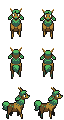
Cervantes is a rare Nature-type creo, perfectly camouflaged in the forest and built to move silently under a dense canopy.
A Cervantes hide is a valuable commodity for the lucky few who ever find one in the woods.
Biology
Cervantes' usual coat is deep brown marked with forest green: spots along the rump, a ruff around the neck, and a shock of hair capping the head, with green hind fetlocks, tail, beard, nose, and ear flaps to match. Its green eyes glow faintly in forest twilight, just enough to see by without drawing attention.
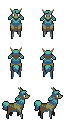
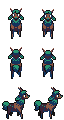
The balance of brown to green shifts through the year with the seasons, and the green fades almost entirely in winter, sometimes all the way to white. Its two spiraling brown horns grow all year and are shed every spring, along with a full shedding of its skin.
Pressed, Cervantes can hit 45 km/h in short bursts, weaving effortlessly between trees.
Their diet leans heavily on tree nuts such as acorns and hickory nuts, which they crack with exceptionally strong jaws. They have to be careful not to chip a tooth doing it, because their teeth never grow back. When nuts are scarce they also browse leaves, bark, and forest fungi.
Cervantes live in old-growth forest with thick undergrowth and plenty of nut-bearing trees. They are crepuscular, meaning most active in the morning and evening, when the light favors their camouflage. They are mostly solitary but hold loose, overlapping territories. When two meet, especially during mating season, friendly roughhousing often turns less friendly, with headbutts, sharp kicks, and antler jabs. So even though their camouflage keeps most dangers away, Cervantes tend to carry an assortment of scars from scrapes with their own kind, at least until spring renews their coats.
Description
Perfectly camouflaged in the forest, Cervantes is a rare creo to encounter.
Perfectly camouflaged in the forest, CERVANTES is a rare Creo to encounter.



 Vitality
 Endurance
 Attack
 Special Attack
 Special Defense
 Defense
 Speed
Speed
 Nibble
 Normal
 Recover
 Vine Lash
 Nature
 Lance
Lance Acid Spores
 Kick
Kick Shed Skin
 Mass Grove
 Nut Cracker
 Leaf Cannon
 Exa Lance
 Bold Vigor
 Leaf blade
 Petal blast
 Focused Power
 Leaf Dart


 Atmo Cannon
 Air
Air
 Void Cannon
 Dark
Dark
 Sand Blast
 Earth
Earth
 Photon Cannon
 Light
Light
 Sap
Sap
 Headbutt
 Decompose
 Giga Blast
 Hydro Cannon
 Water
Water
 Miasma
 Illusion
 Stalagmite
 Defibrillate
 Electric
 Flamethrower
 Fire
Fire
 Radiate
 Sap
Sap
 Agility
 Mass Grove
 Ice Pick


 Ride
Ride Chop
Chop Hop
Hop